
Updated: 27 November 2026
Short answer
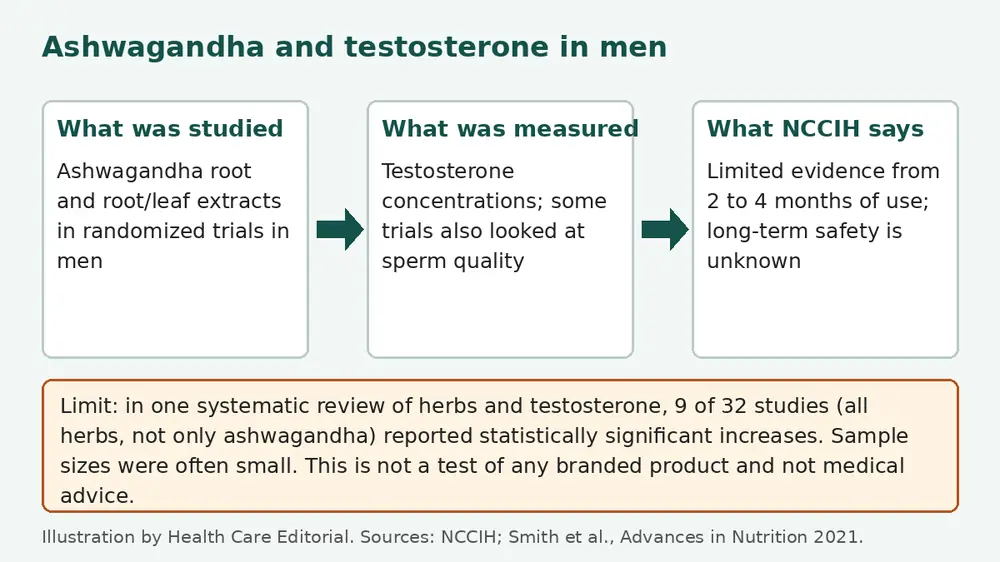
Ashwagandha for men has limited evidence behind it. The National Center for Complementary and Integrative Health (NCCIH) says there is some limited evidence that taking ashwagandha for 2 to 4 months may increase testosterone levels and sperm quality. A 2021 systematic review of herbs and testosterone in men found that ashwagandha root and root/leaf extracts had positive effects, but the authors say more research is needed before firm conclusions on efficacy and safety. Ask a clinician before using it, especially with thyroid, autoimmune or liver problems, or hormone-sensitive prostate cancer.
Ashwagandha is an herb used in supplements, usually as root or root and leaf extract. NCCIH notes these supplements are often promoted for stress and anxiety, sleep, male infertility and athletic performance. This page sticks to what those sources say about men and testosterone, and what they do not say.
What does NCCIH say about ashwagandha for men?
On its ashwagandha page, NCCIH states that there is some limited evidence that taking ashwagandha for 2 to 4 months may increase testosterone levels and sperm quality. It also says there is not enough evidence to decide whether ashwagandha helps other conditions it lists, including athletic performance and cognitive function (NCCIH, Ashwagandha: Usefulness and Safety, read 27 November 2026).
“Limited” is the key word. It describes a small body of research, not a proven effect.
What did the systematic review of herbs and testosterone find?
Smith and colleagues reviewed randomized controlled trials of single herbal ingredients and testosterone concentrations in men aged 18 and over. They found 13 herbs in 32 studies published between 2001 and 2019. Their main findings were that fenugreek seed extracts and ashwagandha root and root/leaf extracts have positive effects on testosterone concentrations in men (Smith et al., Advances in Nutrition, 2021, abstract read 27 November 2026).
| Item | What the review reports |
|---|---|
| Studies and herbs | 32 studies, 13 herbs, published 2001 to 2019 |
| Statistically significant increases | 9 of 32 studies (all herbs, not only ashwagandha) |
| Low risk of bias | 6 of 32 studies |
| Who was studied | Mostly young, nonclinical groups; 16 of 32 studies used men under 40 |
| Authors' caution | Conclusions are limited by few studies for many herbs, varying doses and extracts, small samples and different study designs |
What are the limits of this evidence?
Three limits stand out in the sources. First, the review covers many herbs, so the 9 of 32 figure does not describe ashwagandha alone. Second, most of the men studied were young and not patients, so the results may not apply to older men or men with a diagnosed condition. Third, doses and extracts varied, so one product cannot be assumed to match another.
A higher testosterone number also does not by itself show a better outcome for a person. Testosterone affects sex drive, muscle and bone, and sperm production, and a blood test alone cannot diagnose a condition (MedlinePlus, Testosterone Levels Test, read 27 November 2026).
What does a testosterone test show?
MedlinePlus explains that a testosterone levels test measures the hormone in a blood sample, usually taken in the morning between 7 and 10, when levels are typically highest. A total testosterone test is the most common type. A result that is outside the usual range, together with symptoms, may point to a health problem, but the test cannot diagnose one alone. If you have symptoms such as low sex drive, ask a clinician about testing rather than starting a supplement first.
Is ashwagandha safe for men to take?
NCCIH says ashwagandha may be safe in the short term, up to 3 months, and that there is not enough information to draw conclusions about long-term safety. Liver injury linked to ashwagandha supplements is rare but has been reported. NCCIH also lists these cautions:
- Avoid it during pregnancy and breastfeeding.
- It is not recommended before surgery, or for people with autoimmune or thyroid disorders.
- It might interact with medicines for diabetes and high blood pressure, immunosuppressants, sedatives, anti-seizure medicines and thyroid hormone medicines.
- Because ashwagandha may increase testosterone levels, people with hormone-sensitive prostate cancer should avoid it.
Frequently asked questions
Does ashwagandha increase testosterone?
NCCIH says there is some limited evidence that it may over 2 to 4 months. The 2021 systematic review reported positive effects for ashwagandha root and root/leaf extracts but called for more research.
How long was ashwagandha used in the research NCCIH describes?
NCCIH refers to use for 2 to 4 months. It does not give a recommended dose, and neither does this page.
Can ashwagandha replace testosterone treatment?
The sources reviewed here do not say that. The review describes testosterone replacement therapy as the main treatment for low testosterone and herbs as an option that has been explored. Decisions about treatment belong with a clinician.
Who should not take ashwagandha?
NCCIH advises avoiding it in pregnancy and breastfeeding, and says it is not recommended for people about to have surgery or with autoimmune or thyroid disorders. People with hormone-sensitive prostate cancer should avoid it.
Does the FDA approve dietary supplements before they are sold?
No. According to NCCIH, dietary supplements are not approved by the FDA before they are sold, and that makers are responsible for evaluating safety and labeling before marketing.
References
- National Center for Complementary and Integrative Health. Ashwagandha: Usefulness and Safety. https://www.nccih.nih.gov/health/ashwagandha
- Smith SJ, Lopresti AL, Teo SYM, Fairchild TJ. Examining the effects of herbs on testosterone concentrations in men: a systematic review. Advances in Nutrition. 2021;12(3):744-765. PubMed: https://pubmed.ncbi.nlm.nih.gov/33150931/
- MedlinePlus. Testosterone Levels Test. https://medlineplus.gov/lab-tests/testosterone-levels-test/
All references were read on 27 November 2026.
This article is for educational information only and is not medical advice. It does not replace advice from your own health care provider about diagnosis or treatment.
Sources checked: see References. Page updated 2026-11-27. Written by Health Care Editorial.