
Updated: 27 November 2026
Short answer
The NIH Office of Dietary Supplements (ODS) lists 11 mg of zinc a day as the recommended amount for adult males. The upper limit for adults is 40 mg a day from all sources combined: food, drinks, supplements and medicines. Most men can get zinc from food. Taking more than the upper limit for a long time can cause problems such as low copper levels. Talk to a clinician or pharmacist before taking a zinc supplement, especially if you take antibiotics or a water pill.
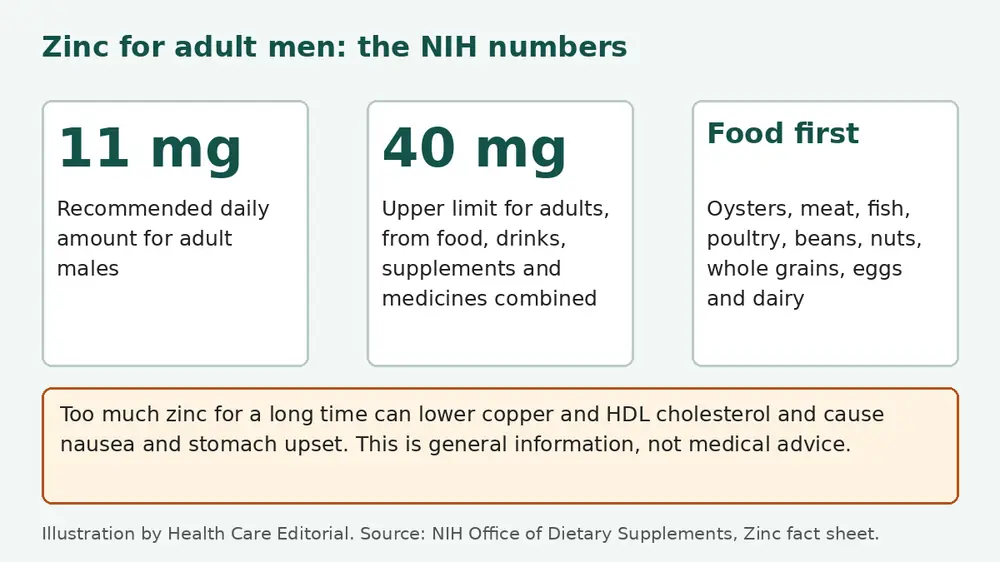
Zinc is a mineral the body needs, and many men ask how much is enough and whether a supplement is worth adding. This page covers what the NIH Office of Dietary Supplements says about amounts, food sources, supplement forms, limits and medicine interactions. It does not recommend any product.
How much zinc do men need each day?
ODS gives the average daily recommended amount for adult males as 11 mg, and for adult females as 8 mg. Teen males aged 14 to 18 years are also listed at 11 mg (NIH ODS, Zinc: Consumer Fact Sheet, read 27 November 2026).
| Life stage | Recommended amount per day |
|---|---|
| Teen males 14 to 18 years | 11 mg |
| Adult males | 11 mg |
| Adult females | 8 mg |
| Upper limit, adults (all sources) | 40 mg |
Which foods contain zinc?
ODS says many foods contain zinc. Oysters have very high amounts. Meat, fish, poultry, seafood such as crab and lobster, and fortified breakfast cereals are also good sources. Beans, nuts, whole grains, eggs and dairy products provide some zinc.
People who follow vegetarian or vegan diets may absorb less, because beans and grains contain phytates that reduce zinc absorption. ODS says vegetarians and vegans might benefit from zinc supplements.
How common is low zinc in men?
The ODS health professional fact sheet reports that, in a US analysis of 2011 to 2014 NHANES data, 8.6% of males aged 10 and older had serum zinc concentrations below the cutoff for sufficiency for their age and sex (NIH ODS, Zinc: Health Professional Fact Sheet, read 27 November 2026). A blood test result needs a clinician to interpret it.
What forms of zinc supplement are sold?
Almost all multivitamin and mineral supplements contain zinc. Zinc is also sold alone or combined with calcium, magnesium or other ingredients. Supplements can contain zinc sulfate, zinc acetate or zinc gluconate. ODS says it is not clear whether one form is better than the others.
Can you take too much zinc?
Yes. ODS lists these signs of too much zinc: nausea, dizziness, headaches, upset stomach, vomiting and loss of appetite. Taking too much for a long time can lead to lower immunity, low HDL cholesterol and low copper levels. Very high doses can reduce magnesium absorption.
The 40 mg upper limit for adults counts zinc from all sources. ODS adds that the limits do not apply to people taking zinc for medical reasons under a doctor's care. It also warns that using large amounts of zinc-containing denture cream, well beyond the label, can cause excess zinc intake and copper deficiency.
Does zinc interact with medicines?
Yes. ODS gives these examples:
- Quinolone antibiotics (such as Cipro) and tetracycline antibiotics can reduce how much of both the zinc and the antibiotic your body absorbs. ODS suggests taking the antibiotic at least 2 hours before, or 4 to 6 hours after, a zinc supplement.
- Penicillamine, used for rheumatoid arthritis and Wilson disease, is absorbed less when taken with zinc. ODS suggests taking them at least 1 hour apart.
- Thiazide diuretics, such as chlorthalidone and hydrochlorothiazide, increase zinc lost in urine. Long-term use might lower the zinc in your body.
Tell your doctor or pharmacist about every supplement and medicine you take.
Frequently asked questions
How much zinc should a man take?
ODS lists 11 mg a day as the recommended amount for adult males. It does not say men need a supplement. Food can supply it.
What is the maximum zinc a man can take?
The adult upper limit is 40 mg a day from all sources combined, unless a doctor directs otherwise.
Does the form of zinc matter?
ODS says it is not clear whether one form (sulfate, acetate or gluconate) is better than the others.
References
- NIH Office of Dietary Supplements. Zinc: Fact Sheet for Consumers. https://ods.od.nih.gov/factsheets/Zinc-Consumer/
- NIH Office of Dietary Supplements. Zinc: Fact Sheet for Health Professionals. https://ods.od.nih.gov/factsheets/Zinc-HealthProfessional/
All references were read on 27 November 2026.
This article is for educational information only and is not medical advice. It does not replace advice from your own health care provider about diagnosis or treatment.
Sources checked: see References. Page updated 2026-11-27. Written by Health Care Editorial.