
Short answer
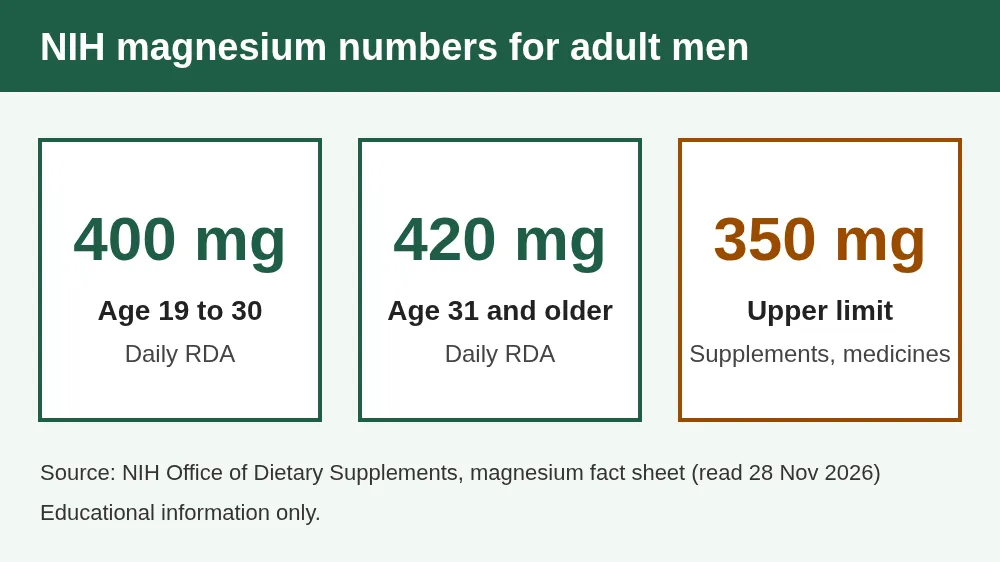
The NIH Office of Dietary Supplements (ODS) lists a recommended magnesium amount of 400 mg a day for men aged 19 to 30 and 420 mg a day for men aged 31 and older. That is the total from food, drinks and supplements. The upper limit that applies to supplements and medicines only is 350 mg a day for adults. Most men can get magnesium from food. Talk to a clinician or pharmacist before taking a magnesium supplement, especially if you have kidney disease or take antibiotics, a bisphosphonate or a water pill.
Magnesium is a mineral involved in many body processes, and men often ask how much is enough and whether a supplement adds anything. This page covers what the NIH Office of Dietary Supplements says about amounts, food sources, supplement forms, limits and medicine interactions. It does not recommend any product.
Related reading on this site: vitamin D for men, zinc for men and the men’s health guides.
How much magnesium do men need each day?
ODS gives a Recommended Dietary Allowance (RDA) by age. These are the values for men.
| Age | RDA for men | Upper limit for supplements and medicines |
|---|---|---|
| 19 to 30 years | 400 mg | 350 mg |
| 31 to 50 years | 420 mg | 350 mg |
| 51 years and older | 420 mg | 350 mg |
The Daily Value printed on labels is 420 mg for adults. The 350 mg upper limit covers magnesium from supplements and medicines only, not magnesium that occurs naturally in food. ODS says the kidneys remove extra magnesium from food in healthy people.
Do most men get enough from food?
ODS cites a national survey (NHANES 2013 to 2016) in which 48% of Americans of all ages ate less magnesium from food and drinks than their estimated average requirement, and it names men aged 71 and older as most likely to have low intakes. ODS also says that symptomatic deficiency from low diet alone is uncommon in otherwise healthy people. Low levels are more often linked to long-term alcohol misuse, bowel conditions such as Crohn’s disease or celiac disease, type 2 diabetes, or certain medicines.
Which foods contain magnesium?
ODS lists green leafy vegetables, legumes, nuts, seeds and whole grains as good sources, and notes that foods high in fiber tend to provide magnesium. These are some of its examples.
| Food | Magnesium | Share of the 420 mg Daily Value |
|---|---|---|
| Pumpkin seeds, roasted, 1 ounce | 156 mg | 37% |
| Almonds, dry roasted, 1 ounce | 80 mg | 19% |
| Spinach, boiled, half a cup | 78 mg | 19% |
| Black beans, cooked, half a cup | 60 mg | 14% |
What forms of magnesium supplement exist?
Supplements come as magnesium oxide, citrate, chloride and other forms. The Supplement Facts panel states the amount of elemental magnesium, not the weight of the whole compound, so compare that line when you read a label. ODS says forms that dissolve well in liquid are absorbed more completely, and that small studies found the aspartate, citrate, lactate and chloride forms were absorbed more completely than magnesium oxide and sulfate. ODS does not say which form is better for any health goal.
What does the research show for common reasons men ask about?
ODS reviews several areas and reports mixed or modest results. For blood pressure, trials found only small reductions: a Cochrane review of 12 trials in 545 people with high blood pressure reported about a 2.2 mmHg drop in diastolic pressure. For type 2 diabetes, ODS says only a few small, short-term trials exist and their results conflict. For migraine, the evidence is limited. ODS does not discuss testosterone, sleep quality or athletic performance as established uses of magnesium, and this page makes no claim about them.
Upper limits and side effects
High doses of magnesium from supplements or medicines can cause diarrhea, nausea and abdominal cramping. Very large doses can cause magnesium toxicity, with low blood pressure, vomiting, difficulty breathing and an irregular heartbeat. ODS reports that magnesium toxicity has been associated with very large doses of magnesium-containing laxatives and antacids (typically over 5,000 mg a day of magnesium). People with kidney problems clear magnesium less well, so they should ask a clinician before using a supplement.
Which medicines interact with magnesium?
- Oral bisphosphonates (for osteoporosis, such as alendronate): magnesium can reduce their absorption. ODS says to take magnesium at least 2 hours before or after them.
- Tetracycline and quinolone antibiotics (such as doxycycline, ciprofloxacin and levofloxacin): ODS says to take the antibiotic at least 2 hours before or 4 to 6 hours after a magnesium supplement.
- Diuretics: long-term loop and thiazide diuretics can increase magnesium loss in urine.
- Proton pump inhibitors: long-term use (typically over a year) can lower blood magnesium, and FDA advises clinicians to consider checking levels.
References
- NIH Office of Dietary Supplements. Magnesium: Fact Sheet for Health Professionals. https://ods.od.nih.gov/factsheets/Magnesium-HealthProfessional/
This reference was read on 28 November 2026.
This article is for educational information only and is not medical advice. It does not replace advice from your own health care provider about diagnosis or treatment.
Sources checked: see References. Page updated 2026-11-28. Written by Health Care Editorial.