
Short answer
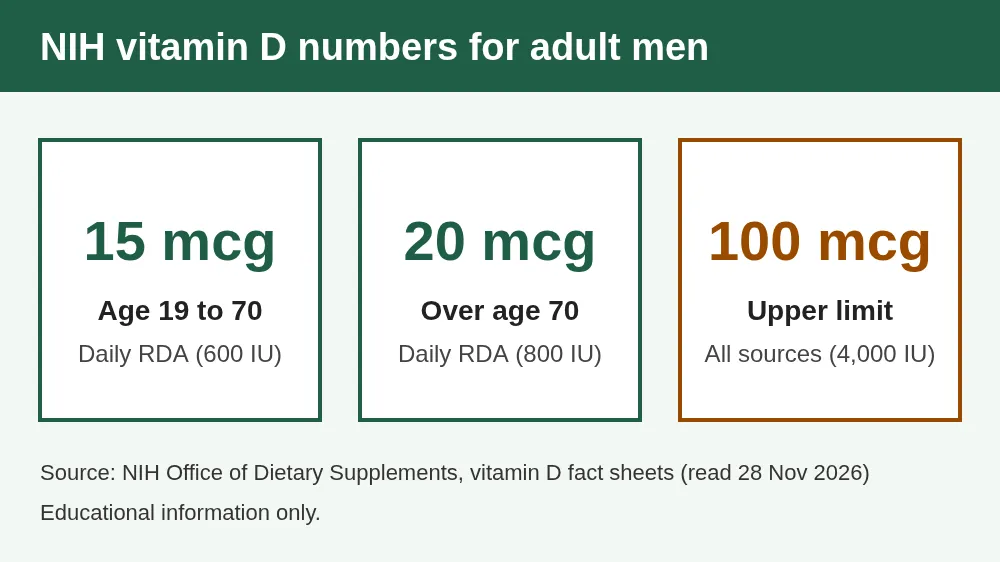
The NIH Office of Dietary Supplements (ODS) lists a recommended vitamin D amount of 15 mcg (600 IU) a day for men aged 19 to 70 and 20 mcg (800 IU) a day for men over 70. The upper limit for adults is 100 mcg (4,000 IU) a day from all sources: food, drinks and supplements. Blood levels, not intake alone, show vitamin D status. Ask a clinician before taking a vitamin D supplement, especially if you take a thiazide diuretic, a statin, a steroid or orlistat.
Vitamin D helps the body handle calcium and supports bone health. This page covers what the NIH Office of Dietary Supplements says about daily amounts, food and sun sources, blood tests, the upper limit and medicine interactions. It does not recommend any product.
Related reading on this site: magnesium for men, zinc for men and the men’s health guides.
How much vitamin D do men need each day?
| Age | Recommended amount (RDA) | Upper limit, all sources |
|---|---|---|
| 19 to 50 years | 15 mcg (600 IU) | 100 mcg (4,000 IU) |
| 51 to 70 years | 15 mcg (600 IU) | 100 mcg (4,000 IU) |
| Over 70 years | 20 mcg (800 IU) | 100 mcg (4,000 IU) |
One microgram (mcg) of vitamin D equals 40 IU. The Daily Value on labels is 20 mcg (800 IU) for adults. ODS says the RDAs assume people get little vitamin D from the sun. It adds that a health care provider may recommend doses above the upper limit for a period of time to treat a deficiency.
Which foods contain vitamin D?
ODS says few foods contain vitamin D naturally. Fatty fish such as trout, salmon, tuna and mackerel, and fish liver oils, are among the best sources. Almost all U.S. milk is fortified with about 3 mcg (120 IU) per cup, and many plant-based milks are fortified too. Foods made from milk, such as cheese and ice cream, are usually not fortified.
| Food | Vitamin D |
|---|---|
| Cod liver oil, 1 tablespoon | 34.0 mcg (1,360 IU) |
| Rainbow trout, farmed, cooked, 3 ounces | 16.2 mcg (645 IU) |
| Sockeye salmon, cooked, 3 ounces | 14.2 mcg (570 IU) |
| White mushrooms exposed to UV light, raw, sliced, half a cup | 9.2 mcg (366 IU) |
Can men get vitamin D from the sun?
The body makes vitamin D when bare skin is exposed to sunlight. ODS says clouds, smog, older age and darker skin reduce how much the skin makes, and that skin does not make vitamin D from sunlight through a window. Sun exposure can also cause skin cancer, so ODS advises limiting time in the sun and using sunscreen with SPF 15 or higher when outside for more than a few minutes.
How is vitamin D status measured?
The main test is the blood level of 25-hydroxyvitamin D, reported in nmol/L or ng/mL (1 nmol/L equals 0.4 ng/mL). The National Academies state that 50 nmol/L (20 ng/mL) or more is sufficient for most people. ODS notes that the levels linked to deficiency have not been definitively identified. In a national survey of 2011 to 2014, 5% of people aged 1 and older were at risk of deficiency (below 30 nmol/L) and 4% had levels above 125 nmol/L (50 ng/mL).
What does the research show?
For bone health, ODS describes a meta-analysis of 11 randomized trials in 34,243 older adults in which vitamin D alone gave no protection from fractures. It also describes a 2022 analysis of the VITAL trial (50 mcg, or 2,000 IU, a day in 25,871 generally healthy adults, median follow-up 5.3 years). Vitamin D did not lower the risk of total fractures, hip fractures or nonvertebral fractures compared with placebo. Most participants were already vitamin D sufficient (only 2.4% had levels below 30 nmol/L), so this result does not address care that a clinician directs for a deficiency. For muscle strength, ODS says results have been inconsistent. For cancer, ODS reports that three meta-analyses of trials found that supplements did not affect cancer incidence and were associated with 12% to 13% lower total cancer mortality. That finding is not evidence that supplements prevent cancer, and it is not a recommendation to use supplements to treat or prevent cancer. ODS does not present vitamin D supplements as a treatment for low testosterone, and this page makes no claim about that.
Upper limits and side effects
Getting too much vitamin D can be harmful. ODS says blood levels above 375 nmol/L (150 ng/mL) can cause nausea, vomiting, muscle weakness, confusion, pain, loss of appetite, dehydration, excessive urination and thirst, and kidney stones. Extremely high levels can cause kidney failure, irregular heartbeat and death. High levels almost always come from taking too much in supplements, not from food or sun.
Which medicines interact with vitamin D?
- Orlistat (a weight-loss drug) can reduce vitamin D absorption from food and supplements.
- Statins (such as atorvastatin, lovastatin and simvastatin) might work less well with high-dose vitamin D.
- Steroids such as prednisone can lower blood vitamin D levels.
- Thiazide diuretics could raise blood calcium too high when taken with vitamin D supplements.
References
- NIH Office of Dietary Supplements. Vitamin D: Fact Sheet for Health Professionals. https://ods.od.nih.gov/factsheets/VitaminD-HealthProfessional/
- NIH Office of Dietary Supplements. Vitamin D: Fact Sheet for Consumers. https://ods.od.nih.gov/factsheets/VitaminD-Consumer/
Both references were read on 28 November 2026.
This article is for educational information only and is not medical advice. It does not replace advice from your own health care provider about diagnosis or treatment.
Sources checked: see References. Page updated 2026-11-28. Written by Health Care Editorial.